Re: I know you all hate American Choppers but...
Posted by seestheday on
URL: http://vintage-and-classic-hondas.81.s1.nabble.com/I-know-you-all-hate-American-Choppers-but-tp4029654p4029931.html
*insert pocket protector*
Sound wave cancellation is real, but only happens in discrete locations/times. Sound waves are literally waves of pressure in the air. An easy way to think of it is to use water as an analogy.
When there is a wave in the ocean there is a depression in the water immediately before the wave. If wave A overtakes wave B the depression of A will temporarily cancel out the peak of wave B (at least partially, depending on the size of the wave). However, as wave A passes through wave B there will be a point where the peak of A and B line up. At this point the size of the peak is A+B so the it will be significantly higher.
Once wave A passes all the way through wave b, then the two waves are now independent and non-interfering again.
So yes sound wave cancellation is real, but with a moving motorcycle it can't account for a decrease in sound volume. It would only have an impact if the bike was stationary and your sensor (e.g. your ear or a mic) was in one of those cancellation zones. If you moved your sensor a bit, then you would hit a peak.
True wave cancellation is a real phenomenon, but only in standing 2-D waves, and even then they are mostly just possible as mathematical models and difficult to create in real life.
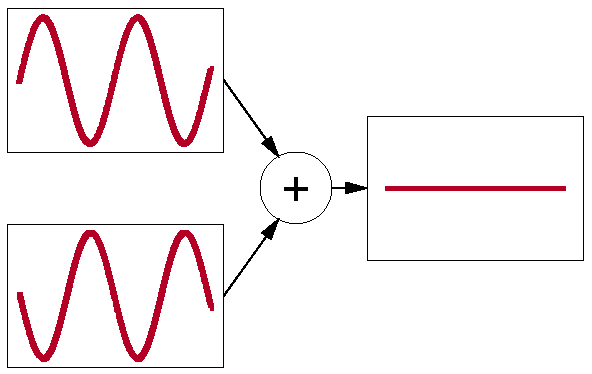
Sound is a 3D wave that radiates from a point source. Here is a 2D representation showing how 2 point sources would interfere with each other. Notice the areas of maximum pressure and minimum pressure. These will correspond to the peaks and troughs I am talking about.
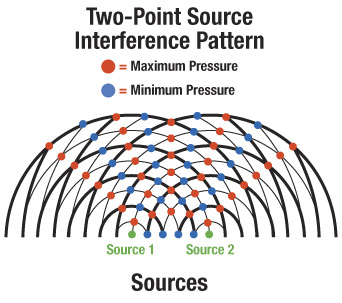
Now, none of this explains why you're getting a quieter exhaust at WOT, but I thought it might help.
URL: http://vintage-and-classic-hondas.81.s1.nabble.com/I-know-you-all-hate-American-Choppers-but-tp4029654p4029931.html
*insert pocket protector*
Sound wave cancellation is real, but only happens in discrete locations/times. Sound waves are literally waves of pressure in the air. An easy way to think of it is to use water as an analogy.
When there is a wave in the ocean there is a depression in the water immediately before the wave. If wave A overtakes wave B the depression of A will temporarily cancel out the peak of wave B (at least partially, depending on the size of the wave). However, as wave A passes through wave B there will be a point where the peak of A and B line up. At this point the size of the peak is A+B so the it will be significantly higher.
Once wave A passes all the way through wave b, then the two waves are now independent and non-interfering again.
So yes sound wave cancellation is real, but with a moving motorcycle it can't account for a decrease in sound volume. It would only have an impact if the bike was stationary and your sensor (e.g. your ear or a mic) was in one of those cancellation zones. If you moved your sensor a bit, then you would hit a peak.
True wave cancellation is a real phenomenon, but only in standing 2-D waves, and even then they are mostly just possible as mathematical models and difficult to create in real life.
Sound is a 3D wave that radiates from a point source. Here is a 2D representation showing how 2 point sources would interfere with each other. Notice the areas of maximum pressure and minimum pressure. These will correspond to the peaks and troughs I am talking about.
Now, none of this explains why you're getting a quieter exhaust at WOT, but I thought it might help.
1981 CB750K with 900 cams
90K KM's, rebuilt head, rebuilt carbs, upgraded valve stem seals
My wife's recipe website that I'm trying to help promote: Strawberries for supper. Yes, I am a lucky man.
90K KM's, rebuilt head, rebuilt carbs, upgraded valve stem seals
My wife's recipe website that I'm trying to help promote: Strawberries for supper. Yes, I am a lucky man.
| Free forum by Nabble | Edit this page |